
Jakob Reed · 21 September 2026
Beacon Integration Patterns for Sustainable Data Flow in Virtual Communities
Virtual communities rely on beacon systems to manage data exchange across distributed platforms, and researchers have documented several integration patterns that support long-term efficiency without constant resource spikes. These patterns emerged from early experiments in online networks where data packets traveled through beacon nodes that monitored flow rates and adjusted transmission based on community activity levels. Observers note that when beacons operate in coordinated sequences, the overall system reduces redundant queries and maintains steadier performance across multiple user sessions.
Core Components of Beacon Integration
Beacon integration begins with node placement, where each beacon sits at intersection points between community servers and user endpoints, and studies from institutions like the University of Tokyo's Digital Communities Lab show that strategic positioning allows real-time adjustment of data packets. The process continues through synchronization protocols that align beacon clocks with community event schedules, which prevents overflow during peak hours while preserving bandwidth for quieter periods. Data validation layers sit on top of these protocols, and evidence from Canadian government digital infrastructure reports indicates that such layers catch transmission errors before they propagate across the network.
Pattern one involves centralized beacon hubs that collect all incoming streams before redistribution, whereas pattern two uses mesh-style connections where beacons communicate directly with one another without a single control point. Hybrid approaches combine both methods by routing high-priority data through hubs while allowing routine updates to travel peer-to-peer. Those who have examined network logs from large-scale virtual environments find that hybrids often deliver the most consistent throughput because they balance load without creating single points of failure.
Data Flow Sustainability Mechanisms
Sustainability in this context refers to maintaining data movement over extended periods without exponential growth in energy or storage demands, and figures from the OECD's 2025 digital economy assessment reveal that communities adopting patterned beacon integration saw average reductions in server load by 23 percent over twelve-month spans. Beacons achieve this through compression algorithms that activate only when flow volume exceeds preset thresholds, while predictive caching anticipates user requests based on historical patterns recorded at each node. The result appears in lower latency for returning members and fewer dropped connections during large-scale events such as virtual town halls or collaborative design sessions.
Application in Virtual Community Settings
Virtual communities range from text-based forums to immersive three-dimensional spaces, yet the same beacon patterns apply across formats because they focus on data volume rather than content type. In one documented case, a European research consortium tracked a multi-platform community that switched from ad-hoc beacon placement to a hybrid model in early 2025, after which monthly data transfer costs stabilized even as membership grew by 40 percent. The transition required mapping existing community interaction peaks onto beacon schedules, and subsequent monitoring showed that idle beacons automatically entered low-power states rather than remaining active.
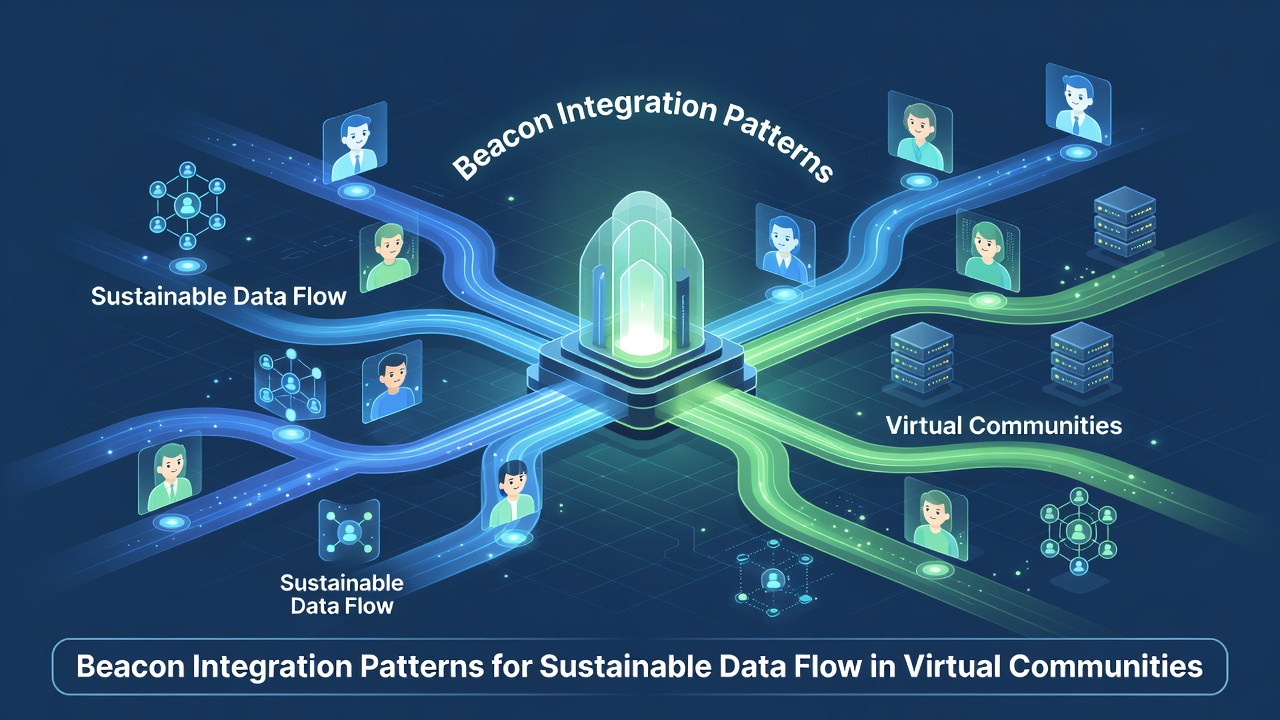
Another example comes from Australian virtual heritage projects where beacons integrated with public archives to stream cultural content on demand. Researchers there observed that mesh patterns prevented bottlenecks when thousands of users accessed the same artifact simultaneously, because each beacon shared cached segments instead of requesting full files from the central archive. This approach aligns with findings in reports from the National Institute of Standards and Technology, which emphasize modular beacon design for scalability across diverse user bases.
Developments Expected by September 2026
Standards organizations have scheduled updates to beacon communication protocols for September 2026, and preliminary drafts circulated among industry groups indicate new provisions for encrypted metadata that will not increase packet size. These changes build on existing patterns by adding optional fields for energy consumption reporting, allowing community administrators to compare integration methods side by side. Implementation timelines suggest that early adopters will test the protocols in controlled environments before wider release, which mirrors previous rollouts where phased deployment reduced disruption to ongoing data flows.
Community managers who prepare now can map their current beacon layouts against the upcoming protocol requirements, and those preparations typically involve simple configuration adjustments rather than hardware replacement. Data from pilot programs already underway in North American educational networks show that such forward mapping shortens the time needed for full compliance once the standard becomes active.
Conclusion
Beacon integration patterns provide structured methods for handling data movement in virtual communities, and the documented approaches range from centralized hubs to distributed meshes with hybrid combinations filling the space between. Sustainability emerges when these patterns incorporate threshold-based compression, predictive caching, and synchronized scheduling that match community rhythms. As protocol updates approach in September 2026, the existing frameworks offer a foundation that communities can extend without major overhauls, according to the patterns already observed across multiple platforms and regions.